Is There a Buyer's Agent in Spain? How to Buy Property as a Foreigner Without Facing the Seller Alone
In Canada, we usually work with one buyer's agent who arranges viewings from all real estate companies, so you can visit several properties over a day or two before making a decision. Here, it seems I have to contact a different agent for every agency. Is that simply how it works in Spain, or is there an equivalent to a buyer's agent that I'm not aware of?
A reader from Canada, planning to retire in Valencia, sent us this question. It is the most precise description of the Spanish property market we have heard.
The short answer: yes, buyer's agents exist in Spain — but they are rare. The system you know from North America or the UK, where one professional represents you across the whole market, is not the default here. Most agents you meet work for the seller. The notary does not represent you either. Unless you bring someone onto your side, you are buying one of your most valuable possessions with no one whose job is to protect your interests.
This guide explains how buying works in Spain, who works for whom, where foreign buyers lose money, and how a buyer's agent changes that.

How buying in Spain differs from the US, Canada and the UK
At home, you probably expect:
- one agent who represents you, the buyer;
- access to almost every property on the market through a shared listing system;
- viewings of several homes from different agencies in one or two days.
In Spain, it usually works differently:
- each agency shows its own listings, and there is no single shared database used by all agents;
- the agent you contact about a listing represents the seller: their job is to sell that property at the best price for the owner and to earn the highest commission;
- to see ten properties, you may need to talk to six or seven different agencies, each with its own process and schedule — and most of their agents speak only Spanish.
In the Valencia area, buyers are also often asked to pay an agency fee themselves — on top of the seller paying theirs. So many buyers end up paying a percentage to an agent who, in the end, still represents the other side.
Is there a buyer's agent in Spain?
Yes. A buyer's agent (sometimes called a property finder or personal shopper inmobiliario) works only for you. In Spain this role is still uncommon, and only a small number of professionals offer it.
A buyer's agent:
- searches the whole market: agencies, private sellers, new developments;
- filters out properties that don't match your brief, before you travel;
- organises viewings so you can see a real shortlist in a few days;
- gives you an honest opinion on each property — including "don't buy this one";
- negotiates the price on your behalf;
- coordinates the legal checks and the steps to completion.
The one question that tells you whether someone is really on your side: who pays them? If the fee comes from the seller, their income depends on the seller's sale. A buyer's agent paid only by the buyer has no reason to push you towards any particular property.
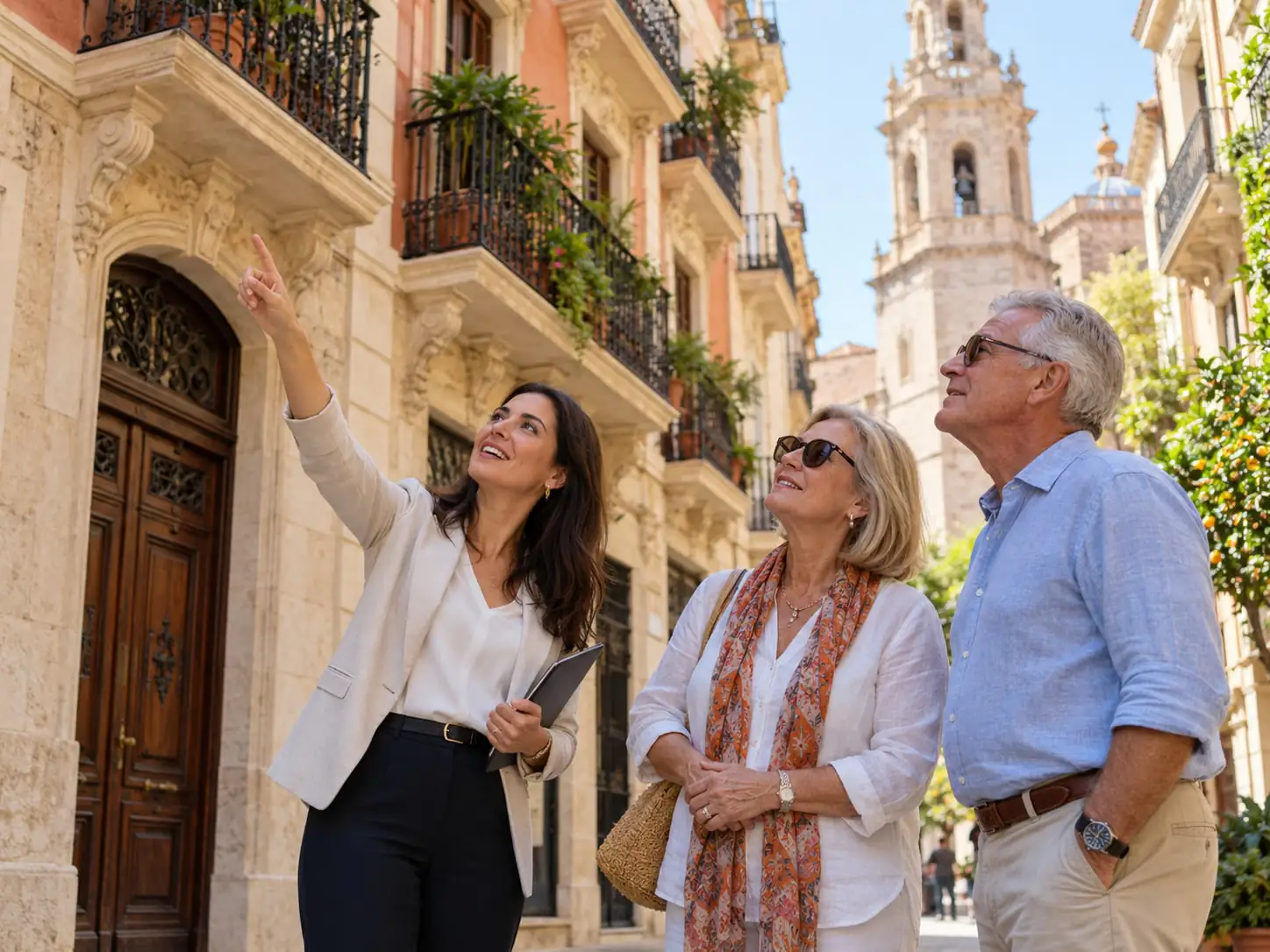
Who works for whom: agent, notary, lawyer
| Role | Who they work for | What they do |
|---|---|---|
| Listing agent (inmobiliaria) | The seller |
Markets the property and closes the sale |
| Notary (notario) | Neither party — a public official |
Certifies the identity of the parties and the legality of the deed, reads it out
and records it
|
| Buyer's lawyer (abogado) | You |
Checks the property's legal status, drafts or reviews the contracts, protects your interests
|
| Buyer's agent | You |
Finds, filters, negotiates and coordinates the purchase |
The most expensive misunderstanding we see: "The notary will protect me." A Spanish notary makes sure the deed is legally correct and signed by the right people. Checking whether the flat has debts, illegal extensions or a problem in the building is not their job.
Do I need a lawyer to buy a house in Spain?
Legally, a lawyer is not required. In practice, buying without one means nobody independent checks the property before you commit money.
A proper legal check usually covers:
- the nota simple from the Land Registry: who owns the property and whether there are mortgages, liens or other charges;
- whether the property as built matches what is registered — extensions, terraces closed in, rooms added without permits;
- outstanding community fees and property tax (IBI);
- the licences the property needs, such as the habitability certificate where applicable;
- the draft contracts before you sign anything.
The arras contract: where most deposits are lost
After you agree on a price, the next step is usually a private contract with a deposit, called a contrato de arras. Typically the deposit is around 10% of the price.
There are three types of arras in Spanish law, with very different consequences. The most common type in property sales means:
- if you withdraw, you lose the deposit;
- if the seller withdraws, they must return double the deposit.
Many buyers from North America expect that a deposit is returned if the deal doesn't go through. Under the most common Spanish arras, it is not.
Before signing arras, make sure:
- the legal checks on the property are already done, or the contract says what happens if they reveal a problem;
- the type of arras is clearly stated;
- the completion date, the price and what's included (furniture, parking, storage) are written down;
- if you need a mortgage, the contract addresses what happens if it isn't approved.
Already looking at properties in Valencia? Before you sign anything, tell us what you're considering on WhatsApp or book a free consultation. We'll explain what to check in your case.

The hidden costs: what you pay on top of the price
The asking price is not your budget. On top of it, expect:
- transfer tax (ITP) on resale homes, set by the Valencia region — or VAT plus stamp duty (AJD) on new builds;
- notary fees for the deed;
- Land Registry fees;
- a gestor to file taxes and register the deed, if you use one;
- legal fees;
- mortgage costs, if you finance;
- a NIE and a Spanish bank account, which you will need before completion.
As a rough guide, total purchase costs come to 13–15% of the price. For a resale home in Valencia, the main items are:
- transfer tax (ITP): 10%;
- the agency's fee, when the buyer is asked to pay one: about 3%;
- notary fees: about 0.7%;
- a buyer's agent, if you use one: 1% with us, plus a success fee.
On a €300,000 flat, that is €39,000–45,000 you need on top.
The asking price is not the price
A listing price in Spain is a starting point for negotiation. Foreign buyers who don't know the real sale prices in a neighbourhood often pay more than necessary simply because nobody told them where the market actually is.
A buyer's agent knows the area, compares what similar properties actually sold for, and negotiates in Spanish. That alone can make a difference that is larger than the fee.
Where it usually goes wrong
From our practice, these are the points where purchases most often go wrong for foreign buyers:
Signing arras before the legal check
Once the deposit is paid, a problem found later can cost you that deposit.
A budget without the extra costs
Planning on the price alone and discovering the 13–15% on top at the notary stage.
Choosing an area from photos or a short visit
For a home you plan to live in for years, the street matters as much as the flat.
Paying a fee to someone who works for the seller
Ask every agent who pays them before you agree to anything.
Arras signed before the mortgage is approved
You usually pay the arras before you apply for the mortgage. Your deposit comes back only if the contract has a clause for the case where the bank says no — we make sure it is there, unless you choose to take the risk.
Buying first, thinking about residency later
The purchase doesn't give you the right to live in Spain.
Common myths
Myth
"There must be a buyer's agent like at home."
Reality
They exist, but they are rare. Unless you look for one, everyone you meet represents the seller.
Myth
"The notary will protect my interests."
Reality
The notary certifies the deed. They don't check the property for you.
Myth
"The deposit comes back if the deal falls through."
Reality
Under the most common type of arras, if you withdraw, you lose it.
Myth
"It's the price plus a few small fees."
Reality
Plan for around 13–15% on top.
Myth
"If I buy a flat, I get residency."
Reality
Spain closed its investor visa for property purchases. Buying property and living in Spain are two separate questions, each with its own route.
How we work as your buyer's agent
Valencia My Home is a boutique relocation consultancy in Valencia. In property purchases, we work only for the buyer and we do not take commission from sellers. Our fee comes from you, so our only interest is that you buy the right property, at the right price, without surprises.
What that looks like:
Brief
We start by understanding what you need: area, budget, size, timing, and how you plan to live in the property.
Search across the market
Agencies, private sellers and new developments — not just one agency's listings.
Viewings
We view properties for you, show them on a live video call or send you video and honest notes, and organise a focused shortlist so your trip to Valencia is spent on homes that are worth seeing.
Negotiation
We negotiate the price and conditions in Spanish, on your behalf.
Legal side
We carry out and control the legal checks on the property, review the arras contract and the deed, and accompany you to the notary. Our team includes a lawyer (abogado).
After the purchase
NIE, padrón, residence documents and taxes — the steps that come after you get the keys.
We currently support property purchases in Valencia and the surrounding area.
How payment works: transparent for both sides
We work under a written service agreement governed by Spanish law, and every payment comes with a VAT invoice.
Payment is split into stages. You make a small advance when we start working together, and the main part of the fee is paid once the result is achieved. This way, you pay for work that has actually been done, and we start working with a client who is committed. Both sides know exactly where they stand at every step.
What you can do yourself
Some buyers manage without a buyer's agent. If you speak Spanish, know the area well, have time to visit agencies one by one, and hire an independent lawyer for the legal checks, you can buy successfully on your own.
Working with us makes sense when:
- you are buying from abroad and can only spend a few days in Valencia;
- you don't speak Spanish;
- you want one person on your side across the whole market;
- you want the legal checks and the purchase handled together, not by people who don't talk to each other;
- you are also planning your move: visa, residence, housing and taxes.
FAQ
Is there a buyer's agent in Spain?
Do I need a lawyer to buy a house in Spain?
What does a Spanish notary do?
What is an arras contract?
How much are the buying costs in Spain?
Can I buy property in Spain as a foreigner?
Thinking about buying in Valencia?
Tell us what you're looking for, your budget and your timeline. On a free consultation we'll explain how the purchase would work in your case, what it will really cost, and where the risks are.
More articles

Moving to Valencia, Spain: The Complete Guide for 2026
Moving to Valencia from anywhere in the world: visas, documents, cost of living, where expats live, renting, schools and the mistakes to avoid.
Read the article →
Renting in Valencia, Spain: Why It's Hard, the Hidden Pitfalls and How to Avoid Scams
Why renting in Valencia is hard, what landlords ask for, the empadronamiento trap, how deposits work, and a checklist to spot rental scams.
Read the article →
NIE, TIE and Green NIE: What Each Document Is and Which One You Need in Spain
NIE, TIE and Green NIE are three different documents. What each one is, who needs which, and in what order to get them when moving to Valencia.
Read the article →